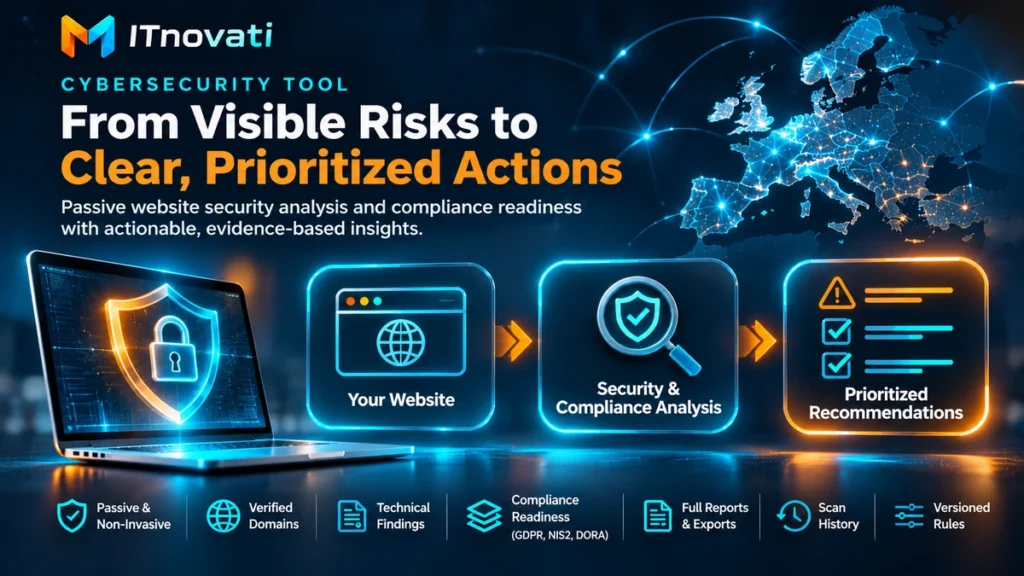
A website security check can help you prepare a developer briefing, investigate a configuration concern or collect initial evidence for a wider review. Its value comes from understanding the observed issue and deciding who should act.
ITnovati Cybersecurity & Compliance Intelligence organises publicly observable website risk and compliance-readiness signals. The offering is listed under Enterprise. Before requesting access, define the website, the concern and the decision you need the assessment to support.
Use this guide to distinguish an actionable technical finding from a question that needs internal evidence or specialist testing.
Security assessment asks whether technology and controls protect systems against relevant threats. Its full scope can include authenticated configuration review, architecture, access controls, patching, logging, processes and penetration testing.
Compliance readiness asks a different question: what evidence exists for particular requirements, and what still needs to be checked? Regulatory and framework obligations depend on the organisation, its jurisdiction, sector, systems and applicable rules.
A passive public website assessment is therefore an early evidence-gathering step, not a legal opinion, certification or complete technical audit.
A reviewer can inspect whether a URL is reachable over HTTPS, whether redirects behave as expected, and what certificate details are served. Problems in this area deserve attention, but a valid certificate does not tell you whether application-level vulnerabilities exist.
Response headers and publicly observable redirect chains can provide useful technical signals. These must be interpreted carefully: a missing optional header is not equivalent to a critical vulnerability, and a protective header does not guarantee that application security is sound.
An external reviewer may encounter information that the site deliberately or accidentally makes public. A finding should identify what was observed, why it matters and how confident the reviewer is. Never assume that a visible endpoint is exploitable without further authorised verification.
Publicly observable cookies, script behavior and browser-facing policies may support initial privacy-related questions. They do not reveal the organisation’s full data inventory, legal basis, contracts or internal processing practices.
Mistake 1: ‘100/100 means secure.’ An automated score reflects a defined checklist or model. Threats outside that scope remain outside it.
Mistake 2: ‘No finding means no vulnerability.’ Absence of an observable signal is not evidence that an application has no vulnerabilities. Some flaws require authenticated, manual or intrusive tests that passive scanning deliberately avoids.
Mistake 3: ‘A configuration issue is a legal violation.’ Technical signals can indicate a gap worth examining; legal conclusions require applicable requirements and appropriate interpretation.
Mistake 4: ‘Missing data means failure.’ An unavailable measurement, inaccessible endpoint or unverified control should be identified as unknown or requiring manual review. It should not automatically be converted to either pass or fail.
Consider an illustrative example: a review reports that HTTP-to-HTTPS redirection is inconsistent for one URL. The useful next step is not to declare the entire organisation non-compliant; it is to verify the redirect chain, determine which hosts and paths are affected, remediate the configuration and test again.
ITnovati Cybersecurity & Compliance Intelligence is described publicly as a passive website risk and compliance-readiness assessment with tailored Enterprise access. It aims to organise publicly observable signals into structured findings. This description should not be read as confirmation that it performs authenticated penetration tests, certifies legal conformity or substitutes for specialist audits.
The wider ITnovati Intelligence Suite also includes SEO and visibility tools, but their separate scores are not security indicators.
Before acting on an automated result, ask:
External checks are most valuable when they create prioritised questions and verifiable evidence. They become less valuable when they imply certainty that the underlying test cannot provide. Use public website intelligence to decide where investigation should begin, then apply the appropriate technical and governance processes to complete the assessment.
Before contacting ITnovati, write down the domain, the public-facing service it supports, the reason for the review and the decision you need to make. Mention whether the question concerns an observed configuration issue or a broader readiness discussion. Share sensitive evidence only through a suitably agreed channel.
An example brief might read: “We operate a customer enquiry website and need to understand which public technical findings require our developer’s attention.” This is an illustrative brief, not a customer case study.
Bring the findings back to the wider website review: use SEO Analyzer for on-page questions and Google Visibility for page experience. Their results support different decisions.
Discuss your assessment scope: Contact ITnovati about your website review. Include the domain, your main concern and the decision the assessment should support. Enterprise access and scope need to be confirmed.
No. A website security check can examine public responses, while account permissions, application logic and internal controls need their own authorised review. An HTTPS connection protects transport; it does not establish that every application function is safe.
Give the authorised domain, business context, affected URL and the finding you want explained. A website security check is more useful when the reviewer can distinguish an informational observation from a reproducible issue. Never send passwords or personal customer data through an enquiry.
Assign an owner, validate the observation and document a proportionate next step. Repeat the relevant website security check after an approved fix. Keep a dated record of the evidence and remaining uncertainty. A website security check is a starting point, not a penetration-test or compliance certificate.
 ITnovati