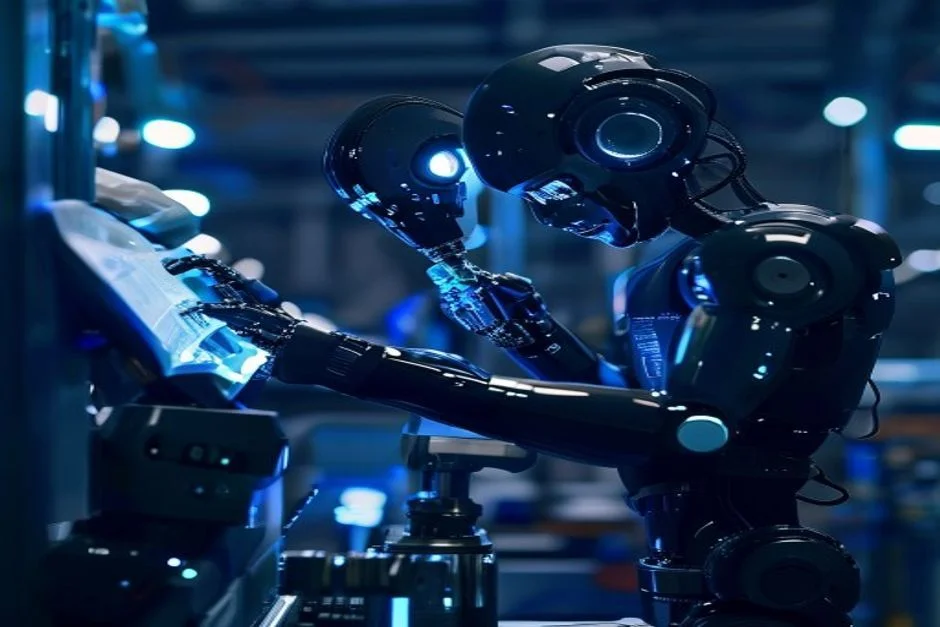
Collaborative robots, or cobots, are industrial robots designed to work safely alongside human workers — without the safety cages and barriers required by traditional industrial robots. In 2026, cobot adoption across European manufacturing has accelerated sharply, driven by labour shortages, rising production costs, and more accessible pricing. According to the IEEE robotics publications, organizations must continuously assess technology risks.
Traditional industrial robots are fast, powerful, and highly accurate — but they operate in isolated cells, separated from workers by safety barriers. They require specialist programming and are expensive to redeployment.

Cobots are built differently:
Cobots handling picking from conveyors, packaging, and placing components in testing fixtures are standard in food processing, electronics assembly, and pharmaceutical manufacturing across Germany, the Netherlands, and Scandinavia.
Loading and unloading CNC machines, injection moulding machines, and other equipment is high-frequency, low-skill work. Cobots are well-suited to this task and free human workers for more complex operations.
The cobot market is dominated by a handful of vendors, with strong European representation:

Cobot ROI varies significantly by application. For high-frequency, single-shift operations, payback periods of 12–18 months are common. For multi-shift operations running 16–20 hours per day, payback can occur in under 12 months.
The key variable is not the robot cost — it is the integration and programming time. Businesses that underestimate deployment complexity often see ROI timelines stretch to 2–3 years. Working with a certified integration partner typically reduces deployment time and improves outcomes.
The biggest barrier to cobot adoption in European manufacturing is not cost — it is the skills gap. While cobots are designed to be user-friendly, businesses still need staff who can maintain, troubleshoot, and redeploy them. Germany, the Netherlands, and Sweden have the most developed cobot training ecosystems; businesses in other EU markets often work with vendor-certified integrators to bridge this gap.
According to the International Federation of Robotics (IFR), cobot shipments to Europe grew 18% year-over-year in 2024, with Germany, Italy, and France leading adoption. The average cobot deployment in a mid-size manufacturing facility delivers payback in 18–24 months.
The highest-ROI cobot deployments share one characteristic: they target repetitive, ergonomically stressful tasks that cause worker fatigue and injury — not tasks requiring dexterity or judgment.
Start with a single task that meets three criteria: repetitive (same motion 500+ times per shift), time-sensitive (delays in this task bottleneck downstream operations), and currently causing quality issues or ergonomic risk. Run a 60-day pilot before committing to fleet expansion.
Cobots are a key component of the broader Smart Factory 4.0 movement in European manufacturing. For the digital backbone that connects cobots to factory systems, see Digital Transformation in 2026.
For further context, review our Robotics coverage and Ai resources.
Not necessarily. Cobots designed for human-robot collaboration (HRC) operate within ISO/TS 15066 force and speed limits, allowing cage-free deployment in most applications. However, a formal risk assessment is mandatory before removing safety barriers — the task type and environment determine what safeguards are required.
Modern cobots from Universal Robots and Doosan Robotics use graphical, tablet-based programming interfaces. A line supervisor can learn basic task programming in one to two days of training. Complex vision-guided or force-sensitive tasks require more specialized skills or vendor support.
Collaborative robots operate under a distinct safety framework compared to traditional industrial robots. ISO/TS 15066 defines the safety requirements for human-robot collaboration, including limits on contact forces, speed thresholds for different collaboration modes, and risk assessment requirements. European manufacturers deploying cobots must demonstrate compliance with this standard and the Machinery Directive (transitioning to the new Machinery Regulation) through documented risk assessments and safety validation testing.
The practical safety assessment process typically involves identifying all possible interaction scenarios between human workers and the cobot, calculating worst-case forces and pressures, and comparing these against the biomechanical limits specified in ISO/TS 15066. Where forces exceed safe limits in specific scenarios, additional controls — barriers, speed restrictions, force-limited tool options — are required. Safety integrators with cobot-specific expertise are recommended for manufacturers deploying cobots in complex human-robot interaction scenarios for the first time.
Cyber-physical security is an emerging consideration for connected cobots. Cobots that receive task instructions from cloud platforms or edge systems are increasingly being targeted by cybersecurity researchers demonstrating that manipulated motion commands can cause cobots to operate unsafely. Manufacturers should ensure that cobot command interfaces are not exposed to untrusted networks and that authentication is required for any system that can modify cobot motion programmes or safety configurations.
Traditional industrial robots operate at high speeds within guarded cages that physically separate them from human workers. Collaborative robots are designed to work alongside humans in shared workspaces, using force-sensing, speed monitoring, and safety-rated stop functions to prevent injury on contact. This makes cobots more flexible and deployable in space-constrained environments, but typically slower and with lower payload capacity than traditional industrial robots. The boundaries are blurring as cobot performance improves and traditional robots gain collaborative safety functions.
Universal Robots (Denmark) is the global cobot market leader and dominant in Europe. KUKA (Germany), ABB (Switzerland/Sweden), and FANUC (Japanese with strong European presence) are significant players with broad product portfolios. Franka Emika (Germany), now operating as Franka Robotics, produces a highly capable and affordable cobot platform with a strong research and SME customer base. Comau (Italy) and Stäubli (Switzerland) serve specialised industries. European manufacturers benefit from strong local support networks and familiarity with EU safety standards.</p
Building a credible business case for cobot investment requires going beyond simple payback period calculation. A thorough ROI assessment should include direct labour cost savings, quality improvement value (reduced scrap, rework, and warranty costs), throughput gains from consistent cobot cycle times, and avoided costs from worker injuries or ergonomic injuries in repetitive tasks. European manufacturers often underestimate the quality improvement contribution — in precision assembly and inspection applications, cobots with vision systems consistently achieve lower defect rates than manual processes, and the value of this quality improvement can exceed direct labour savings.f this quality improvement can exceed direct labour savings.
Ongoing operational costs need to be built into the business case: maintenance contracts, end-of-arm tooling replacement, programming time for new product changeovers, and periodic safety assessments. Cobots from established European suppliers typically have published maintenance cost data that procurement teams can use for realistic financial modelling. Total cost of cobot ownership over a 5-year period, compared to equivalent human labour costs including social charges, training, and absenteeism, consistently shows positive ROI for high-utilisation applications in European manufacturing contexts.
Collaborative robots, commonly called cobots, represent a major shift in how European manufacturers approach automation. Unlike traditional industrial robots that require safety cages and separation from workers, cobots are specifically engineered to work safely alongside human operators on shared production floors.
The European cobot market has grown significantly in recent years. According to the International Federation of Robotics (IFR), European manufacturers invested over €2 billion in collaborative robot systems between 2023 and 2025. This investment reflects a broader trend: manufacturers seeking flexible automation that can be quickly redeployed across different tasks without extensive reconfiguration.
Collaborative robots excel in tasks that require precision, repeatability, and close human-machine interaction. The most common industrial applications include assembly operations, quality inspection, machine tending, packaging, and material handling. Furthermore, cobots are increasingly used for welding and screwdriving tasks where consistent torque is critical.
European automotive manufacturers have been early adopters. Companies like BMW, Volkswagen, and Renault deploy collaborative robots alongside workers on assembly lines to handle repetitive tasks such as bolt tightening and part placement. This arrangement allows human workers to focus on complex decision-making tasks while cobots manage physically demanding or monotonous operations.
Modern collaborative robots incorporate multiple safety mechanisms. Force-torque sensors detect unexpected contact and trigger immediate stops. Vision systems using cameras and LiDAR allow cobots to recognize humans and adjust movement speed accordingly. Additionally, collaborative robots operate under ISO/TS 15066, the international standard specifically governing human-robot collaboration in industrial settings.
Leading cobot manufacturers serving European markets include Universal Robots (Denmark), FANUC (Japan), ABB (Switzerland), KUKA (Germany), and Techman Robot (Taiwan). Each vendor offers different payload capacities, reach specifications, and programming interfaces. Universal Robots’ cobots, for example, can be programmed through a touchscreen interface without specialized robotics knowledge, significantly reducing deployment time.
Return on investment for collaborative robots typically ranges from 12 to 24 months for European SMEs, depending on the application and shift patterns. Initial acquisition costs range from €20,000 to €60,000 per unit, with integration and programming adding 30-50% to the total project cost. Nevertheless, when deployed effectively, collaborative robots reduce per-unit labor costs by 20-40% while improving throughput consistency.
Successful cobot implementation requires careful task analysis, workspace redesign, and worker training. Consequently, manufacturers should conduct a thorough feasibility assessment before purchase, evaluating cycle times, payload requirements, and integration with existing MES or ERP systems. The most successful deployments treat collaborative robots as augmentation tools rather than direct replacements for workers.
The trajectory for collaborative robots in Europe points toward increased intelligence and flexibility. Next-generation cobots will incorporate AI-driven vision systems capable of handling unstructured environments, making them suitable for tasks previously impossible to automate. Accordingly, manufacturers planning automation investments should evaluate cobot platforms with software ecosystems that support continuous capability expansion through firmware updates and add-on modules.
European policy also plays a role. The EU’s Horizon Europe program funds robotics research, and the European Robotics Association (euRobotics) actively works with manufacturers to develop standards that accelerate safe cobot adoption. For IT leaders and operations managers, understanding collaborative robots and the cobot ecosystem is increasingly essential for competitive manufacturing strategy in 2026 and beyond.
Editorial disclosure: AI tools may have assisted research, drafting or editing. ITnovati remains responsible for the published text. Time-sensitive technical, legal and product claims should be checked against the linked primary sources.
 ITnovati