
European enterprises deploying AI systems now face two major regulatory frameworks simultaneously — and the GDPR AI Act compliance overlap between them creates obligations that neither regulation addresses in isolation. GDPR has governed personal data processing since 2018. The EU AI Act adds a risk-based classification layer that applies specifically to AI systems — including those that process personal data. The result is a dual-compliance requirement that many organisations are only beginning to understand: every AI system that processes personal data must satisfy both GDPR’s data protection principles and the EU AI Act’s risk management, transparency, and human oversight obligations.
The GDPR AI Act compliance overlap is not merely bureaucratic complexity. The two frameworks approach AI risk from different angles — GDPR focuses on individual data rights and processing legitimacy, while the AI Act focuses on systemic risk, accuracy, and accountability. Furthermore, enforcement is split between data protection authorities (for GDPR) and national market surveillance authorities and the AI Office (for the AI Act), creating coordination challenges that enterprises must proactively address. Organisations that manage these two frameworks in separate silos will face duplicated assessment effort, inconsistent documentation, and gaps that regulators on either side can exploit.
Mapping the GDPR AI Act compliance overlap precisely reveals five areas where obligations intersect and must be addressed jointly.
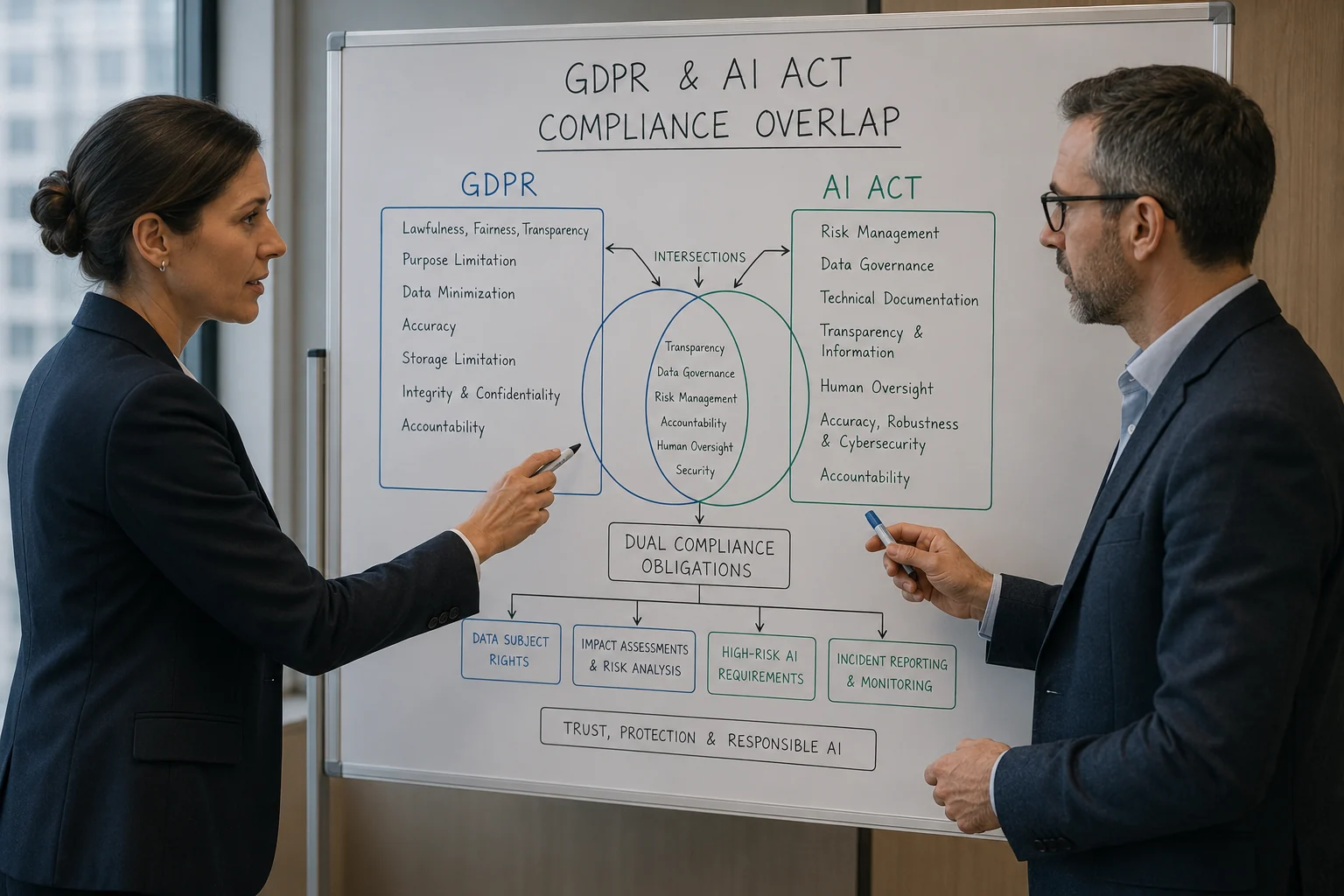
Data Protection Impact Assessments and AI Act risk management. GDPR Article 35 requires a Data Protection Impact Assessment (DPIA) for any AI processing that is likely to result in high risk to individuals — including large-scale profiling, systematic monitoring, and automated decision-making. The EU AI Act Article 9 independently requires a risk management system for all high-risk AI systems. These are not the same document, but their subject matter substantially overlaps: both assess risk to individuals from AI processing, both require documentation of mitigations, and both must be reviewed when the system changes. The practical solution is a unified AI risk assessment document that satisfies both requirements simultaneously, avoiding the resource waste of two parallel processes.
Automated decision-making and human oversight. GDPR Article 22 grants individuals the right not to be subject to solely automated decisions that produce legal or similarly significant effects — and requires human review upon request. The EU AI Act Article 14 requires that high-risk AI systems be designed to allow effective human oversight throughout their operation. The GDPR AI Act compliance overlap here is direct: both frameworks require human intervention capability for consequential AI decisions. However, the AI Act’s requirement is architectural — oversight must be built into the system — while GDPR’s is procedural. Enterprises must satisfy both: a technical override mechanism that a human can actually use, not a policy statement that one is available.
Transparency and explainability. GDPR Article 13 and 14 require that individuals receive meaningful information about automated decision-making logic. The EU AI Act requires that high-risk AI systems be transparent enough for deployers to oversee them effectively, and that limited-risk systems disclose their AI nature. The GDPR AI Act compliance overlap creates a tiered transparency obligation: enterprises must provide individual-level explanations under GDPR and system-level transparency documentation under the AI Act. Additionally, GPAI model providers must publish training data summaries — which may intersect with GDPR obligations if training data included personal data.
Data minimisation and AI training data. GDPR Article 5(1)(c) requires that personal data be adequate, relevant, and limited to what is necessary. Training AI systems on personal data creates tension with this principle: larger datasets generally improve model performance, but GDPR requires minimisation. The GDPR AI Act compliance overlap here is a design challenge — enterprises must justify the volume of personal data used for AI training through legitimate interest or consent, and must implement technical measures such as differential privacy or synthetic data generation to reduce the personal data footprint of AI training pipelines.
Accountability and documentation. GDPR Article 5(2) requires that controllers demonstrate compliance — the accountability principle. The EU AI Act requires technical documentation, conformity assessments, and registration for high-risk systems. Both frameworks require documentary evidence of compliance; the GDPR AI Act compliance overlap means that documentation systems must be designed to serve both frameworks simultaneously. A single AI system register that captures DPIA status, AI Act classification, technical documentation references, and human oversight mechanisms is more efficient and defensible than separate records.
Resolving the GDPR AI Act compliance overlap requires technical architecture decisions, not only policy documents.

Consent and lawful basis management becomes more complex when AI systems are involved. If an AI system processes personal data under legitimate interest, that basis must be documented in the AI Act’s technical documentation alongside the GDPR Record of Processing Activities. However, if the AI system’s purpose changes — a common occurrence as models are fine-tuned or repurposed — both the GDPR lawful basis assessment and the AI Act risk classification may need to be revisited. Build change management processes that trigger both reviews simultaneously.
Data subject rights — access, rectification, erasure, portability — must be technically implementable for personal data processed by AI systems. Therefore, AI systems that process personal data must be designed with data subject rights in mind from the start: the ability to identify an individual’s data within training sets, inference logs, and model outputs is a technical requirement, not an afterthought. For AI systems where individual data cannot be isolated and deleted, alternative mitigations must be documented.
Privacy by design, required by GDPR Article 25, aligns with the EU AI Act’s secure-by-design approach and maps directly to the CRA’s Annex I requirements for products with digital elements. Consequently, enterprises building the GDPR AI Act compliance overlap into their development lifecycle — rather than treating it as a post-deployment audit — benefit from a unified privacy and security by design framework that satisfies all three regulatory layers simultaneously.
The European Data Protection Board (EDPB) and the EU AI Office have begun coordinating their guidance on the GDPR AI Act compliance overlap. The EDPB’s 2025 opinion on AI models and data protection addresses the intersection directly, clarifying that AI systems processing personal data are subject to GDPR in full — there is no AI Act carve-out. Moreover, the AI Office and national DPAs are expected to develop joint enforcement protocols for AI systems that violate both frameworks simultaneously.

Several large-scale GDPR AI Act compliance overlap investigations are already underway in EU member states, targeting AI-powered hiring tools, credit scoring systems, and predictive analytics platforms. These investigations provide early precedent for what regulators expect — and they consistently identify the same gaps: missing DPIAs, inadequate human oversight mechanisms, and insufficient transparency documentation. For organisations building their compliance programmes, see our guides on EU AI Act enterprise compliance, shadow AI enterprise risk, and NIS2 compliance.
Our full AI coverage and IT management resources provide additional context.
Managing the GDPR AI Act compliance overlap requires a unified governance approach that addresses both frameworks through shared documentation and coordinated assessment processes.
The GDPR AI Act compliance overlap refers to the areas where both the General Data Protection Regulation and the EU AI Act impose obligations on the same AI system or processing activity. AI systems that process personal data are subject to GDPR in full — including lawful basis, data subject rights, DPIAs, and accountability — and simultaneously subject to EU AI Act requirements including risk classification, technical documentation, human oversight, and transparency. Managing both frameworks requires unified governance documentation and coordinated assessment processes.
For high-risk AI systems that process personal data — which includes most AI used in HR, credit, healthcare, and law enforcement contexts — both a GDPR Article 35 DPIA and an EU AI Act Article 9 risk management system are required. However, the assessments substantially overlap in subject matter: both address risk to individuals, mitigation measures, and documentation. The most efficient approach is a unified assessment document designed to satisfy both requirements, reviewed jointly by your DPO and AI governance function.
Enforcement of the GDPR AI Act compliance overlap is split between two regulatory authorities. GDPR violations are enforced by national Data Protection Authorities (DPAs) — the ICO in the UK, the CNIL in France, the BfDI in Germany, and so on. EU AI Act violations are enforced by national market surveillance authorities and, for GPAI mode ls, by the EU AI Office directly. Both authorities can investigate the same AI system for different violations simultaneously, and are developing joint enforcement protocols for overlapping cases.
Editorial disclosure: AI tools may have assisted research, drafting or editing. ITnovati remains responsible for the published text. Time-sensitive technical, legal and product claims should be checked against the linked primary sources.
 ITnovati